

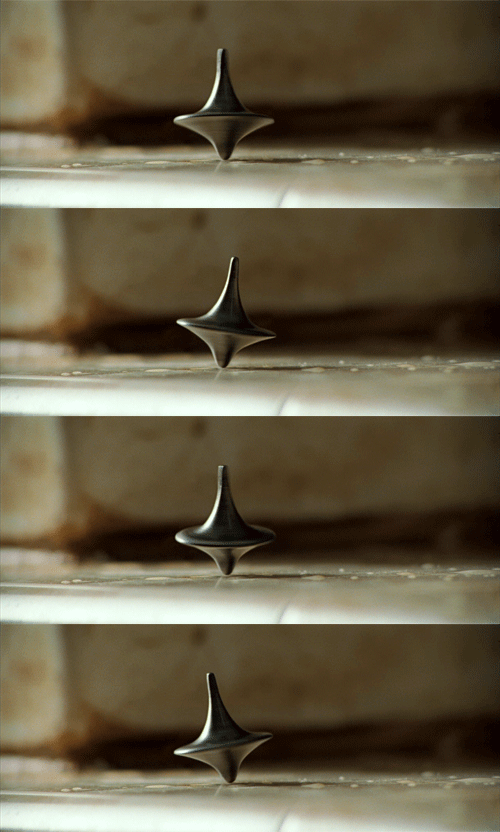

Imagine a top, spinning on a table.
I’d guess that about 97.3% of you pictured a twirling, bottom-weighted piece of brass tapered on both ends like a pulsar star. Why? Because that’s the top used in the 2010 movie, Inception.
Pulsar in the Crab Nebula.
There has been a lot of debate about the meaning of that movie. The biggest of all, of course, is [Spoiler Alert for those who still haven’t watched the movie 16 years after its release…] did the top keep spinning at the end of the movie?
Normally, MacGuffins like this drive me right bonkers, mate. The glowing case in Pulp Fiction is an excellent, erm, case in point. What’s in the briefcase? Answer: a $12 lightbulb. FFS.
But the top in Inception actually did have something to say. Christopher Nolan, the director, put it like this:
“Reality matters,” Nolan says. But… “Think about it this way: can you prove that you are not dreaming? No? You’ll still keep living your life anyway. We don’t have our own spinning tops, but we manage to deal with it. Maybe this means that all subjective levels of reality are valid. What even is reality anyway, man?”
Not everyone “got” the movie. Some found it confusing. Many came to different conclusions about what it all meant. However – and here’s the important part – most who took the movie seriously agreed that it meant something, even if that something was subjective and/or not 100% clear. Nolan himself obviously understood what the MacGuffin meant to him, based on his quote above.
However, too often writers try to pass off unfinished world building and story spinning as “mystery” – and that’s something altogether different.
Upgrade to Paid! Hit the Subscribe Button (even if you’re already a free subscriber).

How to (Not) Build a Mystery
I touched on this topic in my series about common writing mistakes in short story writing. “Writers can’t bluff their way through ignorance,” someone once said – and it’s absolutely true. That’s because readers are sharp, and they can smell BS a mile away. Trying to pass off your own confusion and fog as mystery only leaves the reader with your confusion and fog.
The difference between ignorance and mystery is on the part of the creator. You create fog when you can’t be bothered to figure out what’s happening in your own story. You create mystery when you know the answer and try to lead your reader to that answer in clues. Note: “the answer” may be different for different people; the best ones are exactly that.
I recently read a post by John Fox that puts it perfectly:
“Good [stories] are not created by withholding information. They’re created by delivering a lot of information — because that information raises new questions.” - John Fox
Read the original quote in context here:

John actually uses the word “mysteries”, but I substituted “stories” because the sentiment holds true for both.
Think about an Agatha Christie novel. Christie is one of the most famous mystery writers of all time. When you’re trying to solve her mysteries, all the clues are there. She’s not trying to hide anything.
In fact, the problem isn’t a lack of information; it’s too much information. She buries meaningful answers in a mound of meaningless fluff – at least, meaningless in terms of solving the mystery. Like any good novelist, she makes sure that meaningless fluff still serves to move the plot and/or entertain the reader.
When you think about it, the best stories all have mystery, even if it isn’t a whodunit. Instead, it could be as skeleton in someone’s past, a hidden motivating factor, a connection between two supporting characters that our main character doesn’t know about, but changes everything… any number of a million “mysteries” that readers can have fun discovering.
It only works though if the author knows the answer. Or, at the very least, if the author understands and expertly poses the question that will lead to the reader’s own answer.
But if the author doesn’t have the answers, the readers never will either.
Over to You
Do you ever struggle with an unknown in your story? How do you bring it from unknown to known for the reader? Any other tips for avoiding this trap in the first place? Let me know if the comments below!
Until next time, keep writing with wild abandon!
~Graham


email me if you get lost.